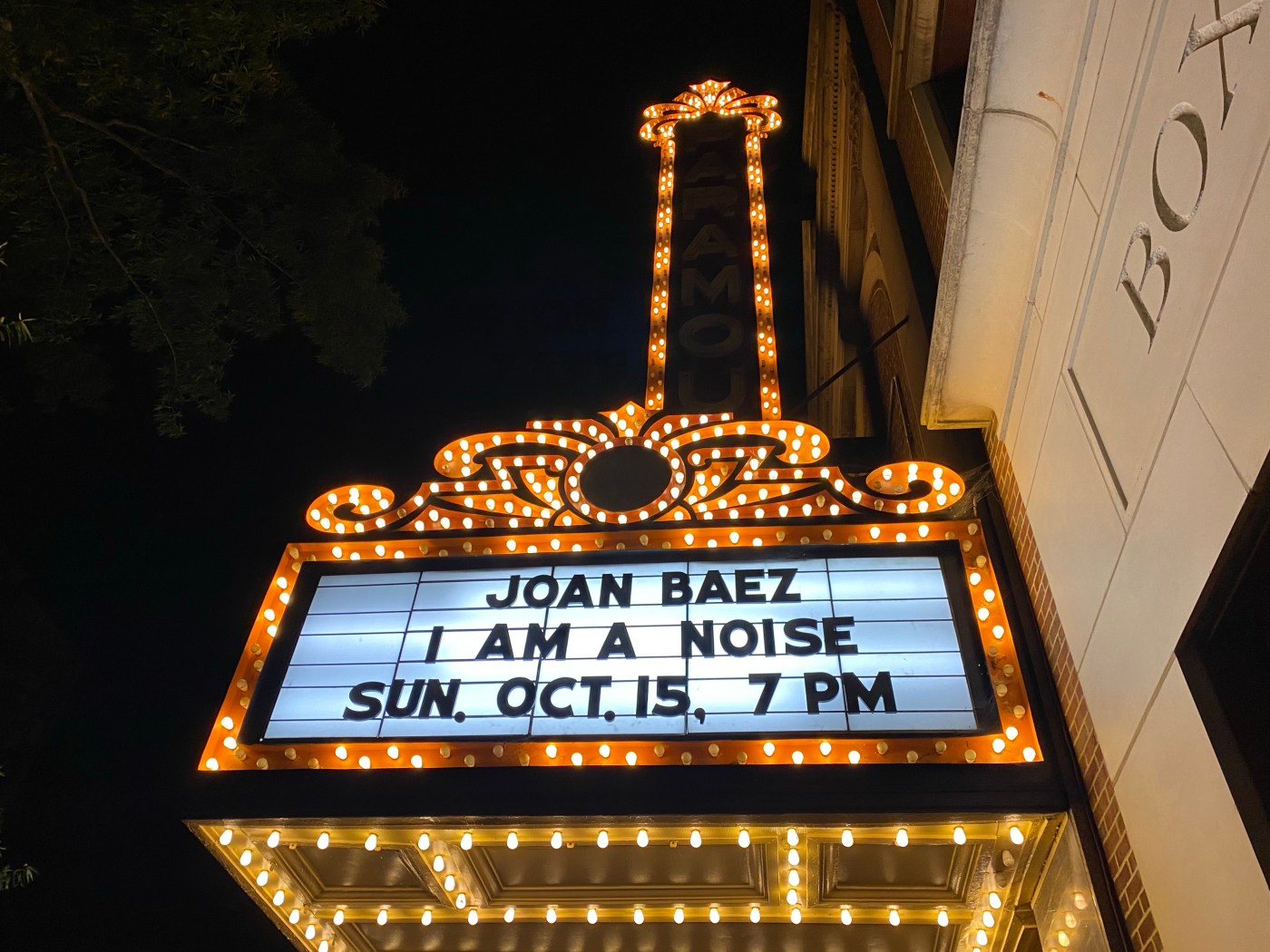
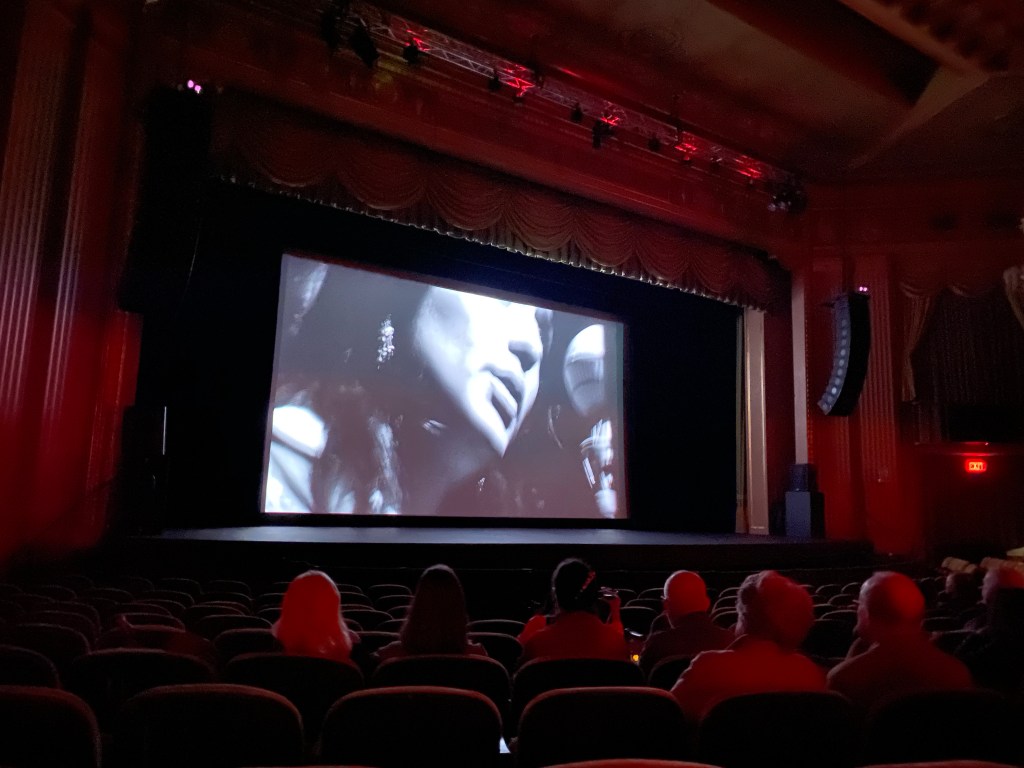
This past weekend, the weekend of my forty-first birthday, I took myself out to see the Joan Baez documentary I Am A Noise. The experience might best be summed up by a conversation I overheard between an usher and a senior citizen on the way out of the theater:
Usher: How was it?
Senior Citizen: It was… all right… I liked her better before I saw it.
Now, I don’t mean to suggest that the documentary made me personally dislike Baez. But what the above exchange highlights is how many people projected certain things onto Baez (who was an earthily stunning eighteen-year-old when she rocketed to folk-singer stardom): a comforting calm, a serene beauty, a larger-than-life, even saintlike status…
…and what the documentary (with the blessing of its subject) makes clear is that she was actually a very flawed, competitive, showboating, neurotic, self-deprecatingly hilarious, intimacy-evading individual.
How relatable.
I first stumbled onto Baez when I played a unlabeled cassette tape I found in a cabinet at my grandparents’ house, and “Diamonds and Rust” came flooding out, having been recorded off a 45 or AM radio. There was a dusky mystery about it that I found intoxicating; it was a, shall we say, collection of symbols of an ambiguous adult world of sex and travel…or something.
(Thirty years later, I still haven’t found that world, though my partner and I have done a bit of exploration of unfamiliar lands trying to come off as little like pack-saddled bumpkins as possible!)
In my college days I revisited “Diamonds and Rust” after a long hiatus and found it had additional layers of meaning to me.
Then, a decade ago, just out of a long relationship and back on the karaoke scene to rediscover in a low-stakes way what being a performer was like, I adopted “Diamonds and Rust” as a staple.
Most recently, I saw an old video of Baez duetting “Plaisir d’amour” with Nana Mouskouri – this on the social media of my Greek great aunt, who likely DID penetrate that “ambiguous adult world of sex and travel,” having come of age at the right time and place to vacation on the island of Hydra proximal to famous (but not yet legendary) Leonard Cohen and his cohort.
In any event, Joanie’s always been around. Her perfect tan is apparently from her Mexican heritage, but I have always felt she would fit right in with my Greek relatives in photos from the seventies: long, sun-browned limbs and an air of self-assertion.
I learned that Baez apparently started off as a bold, creative, and spotlight-loving – but also painfully existential and dark-tempered – kid who was hypersensitive to injustice. At some point in pre-puberty she developed intense anxiety and a powerful inferiority complex. Lousy treatment by Anglo classmates who sensed she had, if you will, a pinch of extra spice to her (I speak from experience here) no doubt exacerbated this, though the documentary also raises disturbing questions of whether a more extreme trauma may have served as a mental health tipping point for her as well as her little sister, Mimi (Fariña).
I also learned that, by her own admission, Baez tended to view adulation as an escape from herself, and that to an extent her activism became an addiction, a sort of workaholism that let her avoid other things she preferred not to confront. It was probably this that was hardest for some members of the AARP audience around me to swallow, though cynical me has always looked for such complexity in seeming altruists, and I’ve never felt it detracted from any good they did.
Baez is also apparently bisexual, which I hadn’t known, though in the context of the documentary she simply mentions a notable girlfriend and no label is used. This being Baez’s career retrospective, ole’ Dylan (or, should I say, Bobby Zimmerman) remains a footnote – albeit a bold-print one. Her first impression of him as a disheveled runt of sorts, but one who oozed charisma and politics, made me smile. She explained that trying to hang around him as he became more persona than human was demoralizing, and she admits he broke her heart because of how close they were for a very short time.
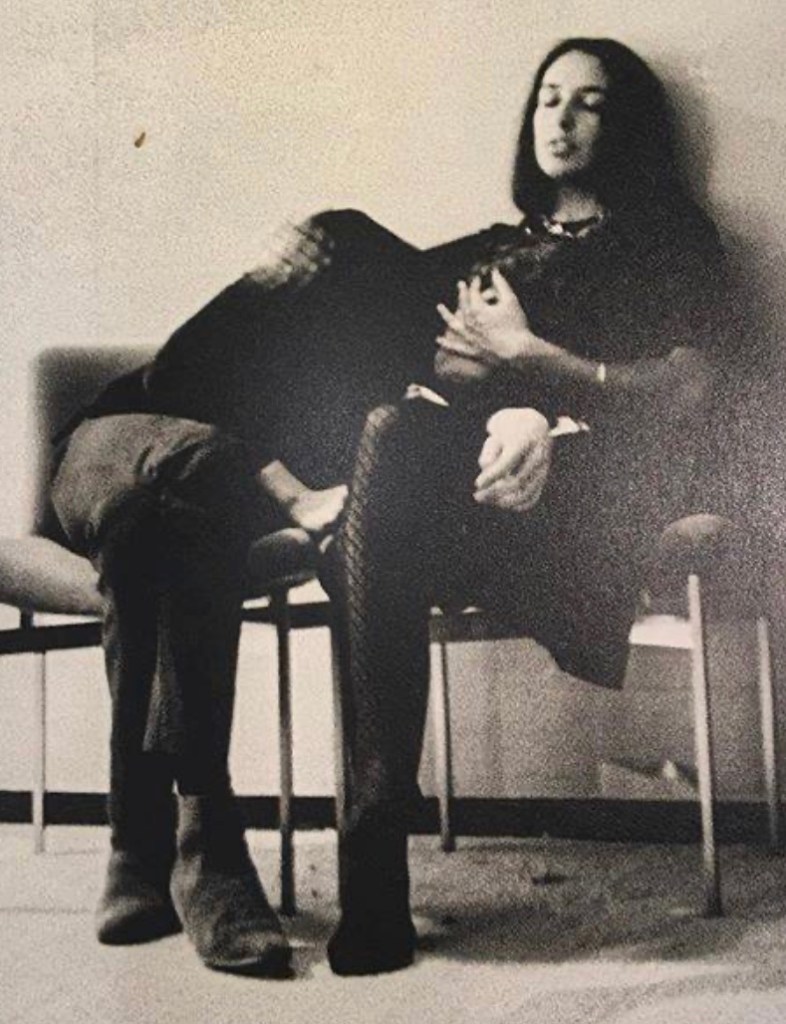
📷: Barry Feinstein (I think)
I am leading up to the serendipitous fact that back in August, well before I knew this documentary even existed, let alone that it would be playing in town, I finally covered and released “Diamonds and Rust” proper. I realized that, some way, somehow, enough time had passed for me to look at it from a middle-aged perspective and really feel those rust stains. It was a natural fit, and my tiny audience seemed to receive it well.
 The Sold Kingdom